

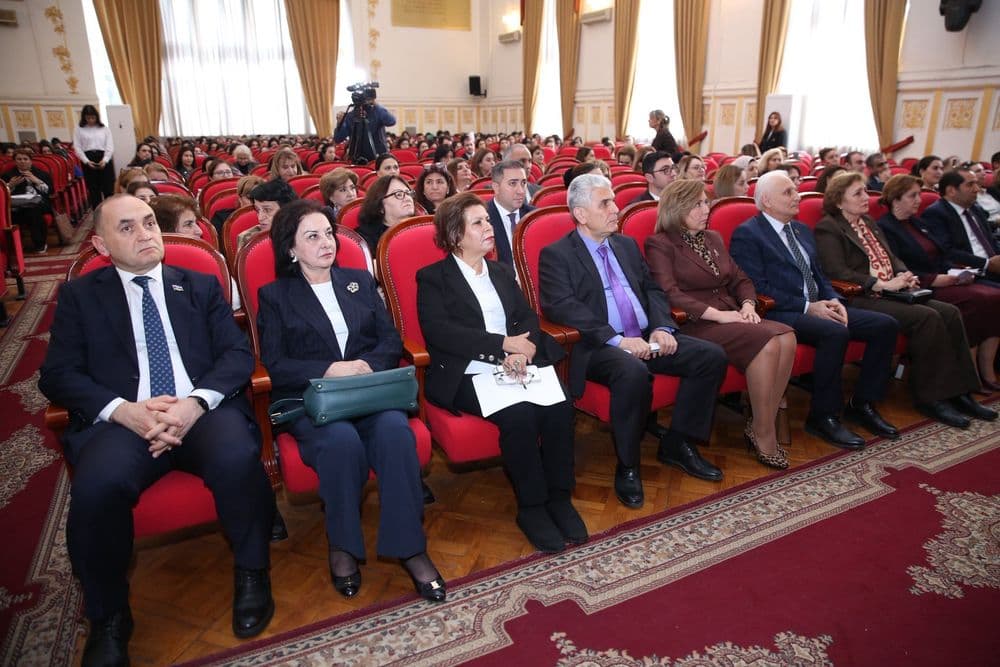
A conference titled “Women’s Participation in Peace and Reintegration Processes: National and International Mechanisms” was held at Azerbaijan State Pedagogical University.
On December 1, the State Committee for Family, Women and Children’s Affairs, jointly with the Western Azerbaijan Community and Azerbaijan State Pedagogical University, organized a conference at ADPU on the topic “Women’s Participation in Peace and Reintegration Processes: National and International Mechanisms” with the aim of raising awareness among the younger generation.
The conference was attended by representatives of the State Committee for Family, Women and Children’s Affairs, the Western Azerbaijan Community, the leadership of the Pedagogical University, representatives of other higher education institutions, members of the Milli Majlis, representatives of central executive authorities, the New Azerbaijan Party and non-governmental organizations, wives of martyrs admitted to higher education institutions over the past five years, participants of the project “Support for the Education of Young Girls,” representatives of the media, the educational community, and university students.
Rector of Azerbaijan State Pedagogical University, Professor Jafar Jafarov, delivered a welcoming address, emphasizing the strategic importance of the event in terms of its theme and noting that it is particularly relevant given the prominence of women’s roles in peacebuilding processes on both global and national agendas.
Stating that the preservation of peace and the consistent implementation of reintegration processes in the modern world are not only the result of military and political decisions but also of broad public consensus, social integration, and the comprehensive implementation of humanitarian policies, the Rector noted that the active participation of women in these processes is one of the most effective approaches confirmed by global experience.
He emphasized that the role of women in society is not limited to legal guarantees alone but also serves as one of the fundamental factors shaping socio-cultural development. In this regard, the educational level of women is a strategic factor influencing the formation of a country’s overall intellectual potential. The Rector added that young women studying at Azerbaijan State Pedagogical University not only acquire knowledge but are also shaped by high moral values, the idea of service to the homeland, and a sense of social responsibility.
“Future women teachers will play an important role in promoting national and moral values in schools, instilling the principles of tolerance and humanism, and fostering healthy social relations in reintegration processes,” said J. Jafarov, emphasizing that, especially in the context of wartime and post-conflict realities, the educational mission of women teachers is even more valuable and essential.
Chairperson of the State Committee for Family, Women and Children’s Affairs, Bahar Muradova, stated that the topic holds special significance both in terms of preserving historical memory and achieving strategic goals. In her speech, she highlighted the unparalleled role of National Leader Heydar Aliyev’s return to Azerbaijan in saving statehood and reviving national will, noting that under his leadership the facts of genocide against Azerbaijanis worldwide and the deportation of the population of Western Azerbaijan were recognized at the state level for the first time and recorded in history.
The Committee Chair noted that this historical trajectory entered a new phase under the policy of President Ilham Aliyev, and that the idea of returning to Western Azerbaijan has become part of the real political agenda. She emphasized that the Head of State has created an important conceptual framework in this direction, encompassing military-political, legal-diplomatic, and socio-economic aspects. The adoption of the Concept of Return to Western Azerbaijan, diplomatic activities, the emphasis on the right of return on international platforms, and continuous support for the Western Azerbaijan Community were cited as clear examples.
Drawing attention to the fact that since its establishment the Western Azerbaijan Community has carried out multifaceted activities as the bearer and initiator of this mission, B. Muradova noted that the Community’s Women’s Council has undertaken important initiatives aimed at collecting the stories of deported women, preserving cultural heritage and traditional crafts—especially carpet weaving—and increasing women’s social activity. She added that these efforts contribute both to strengthening social solidarity and to reinforcing the humanitarian and cultural foundations of the return.
Touching upon the topics included in the conference program, the Committee Chair stated that the presentation of the Western Azerbaijan Oath, legal assessments, cultural heritage issues, historical memory, the enlightenment movement, and the leading role of women in these processes are all important directions that substantiate the idea of return as being based not only on political but also on moral, historical, and humanitarian foundations.
The Committee Chair also noted that within the framework of the “16 Days of Activism against Violence” campaign held in the country, the safety of women and children is one of the priority directions of state policy. While being part of a global initiative, this campaign also serves as a useful platform for presenting the humanistic and modern spirit of national policy. She specifically emphasized the importance of women’s participation in peace and reintegration processes in accordance with UN Security Council Resolution 1325.
Referring to the commemoration of December 2 as the Day of Deported Compatriots, the Committee Chair stated that the aim is not only to remember history but also to strengthen state policy aimed at ensuring peace, prosperity, and secure return in the South Caucasus.
In conclusion, Bahar Muradova wished the conference participants successful discussions and expressed confidence that the event would make a significant contribution to state policy and public activity.
Deputy Chair of the Board of the Western Azerbaijan Community and Member of Parliament Hikmet Mammadov spoke about the humanitarian and legal foundations of the Western Azerbaijan Concept. He noted that the right of our compatriots deported from Western Azerbaijan to return peacefully, safely, and in stages to their historical homelands fully complies with international legal norms. Hikmet Mammadov emphasized that the role of women is particularly prominent in this concept, as they are both carriers of community memory and shapers of peace messages to be passed on to future generations.
He also noted that the active participation of various social institutions, civil society, and state bodies in this process is essential, and that strengthening public awareness activities in this direction is of particular importance. By internalizing the legal and historical aspects, this historic stage of reintegration can be realized.
Subsequently, a video presentation titled “The Western Azerbaijan Oath” was shown.
The event continued in the form of panel discussions moderated by the Chair of the Women’s Council of the Western Azerbaijan Community and Member of Parliament, Melahat Ibrahimqizi. Emphasizing the importance of the topical issues discussed in the auditorium with student participation, she noted that young people will be at the forefront of the return process to Western Azerbaijan.
Member of the Board of the Western Azerbaijan Community and Vice-Rector of Azerbaijan State Pedagogical University, Mahira Huseynova, noted that despite difficulties, our compatriots living in Western Azerbaijan were able to preserve their national identity, language, and religious values during that period. She emphasized that women made significant contributions to cultural enlightenment and spoke about prominent women in this field, expressing confidence in the return to historical lands at the end of her speech.
Drawing attention to the rich cultural heritage of Western Azerbaijan, Member of the Board of the Western Azerbaijan Community and Rector of Azerbaijan University of Architecture and Construction, Gulchohra Mammadova, stated that a large part of this heritage has been destroyed. She provided information about architectural heritage monuments located in Yerevan, emphasized the need for special research in this area, and noted that these monuments deserve inclusion in the list of world cultural heritage.
Member of Parliament Mehriban Valiyeva emphasized in her speech that women have played an important role for centuries in preserving national identity and passing it on to future generations. She noted that it was mothers who raised the heroic sons of the Patriotic War with love for the homeland, national spirit, and historical memory. According to her, this fact once again shows that a people who preserve their historical memory do not lose their national identity and never renounce their lands.
Doctor of Legal Sciences at Baku State University and Chair of the Legal Commission of the Western Azerbaijan Community, Zahid Jafarov, spoke about the fundamental principles of peace and integration processes in international practice. He also emphasized that women’s participation in peace dialogues is recognized as an important factor worldwide.
During the continuation of the event, public activist Lalin Hasanova from Canada and lawyer Eda Gunday from Türkiye delivered speeches via video format. It was noted that women’s participation increases the effectiveness of dialogue in conflict resolution and makes an important contribution to the long-term implementation of decisions and to public participation.
The conference continued with discussions.