

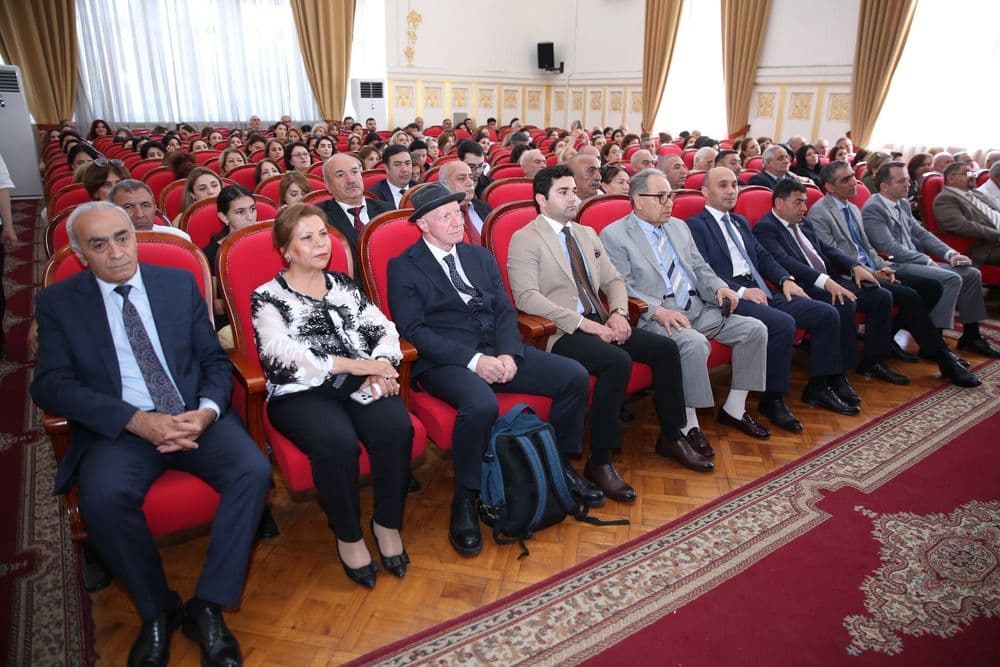
The presentation ceremony of the film “Homeland Living in Memories” was held at the Azerbaijan State Pedagogical University.
The event was attended by the leadership of the Azerbaijan State Pedagogical University, members of the West Azerbaijan Community, parliamentarians, professors and teaching staff, public representatives, and intellectuals.
Vice-rector for International Relations of the Azerbaijan State Pedagogical University, Prof. Mahira Huseynova, parliamentarians Gaya Mammadov and Rizvan Nabiyev, and director Mikael Silkeberg made speeches and noted that the film will be an important source in promoting the customs and traditions, literature, art, national costumes, and cuisine of West Azerbaijan.
It should be noted that the main idea of the film, directed by Swedish director Mikael Silkeberg, is to present West Azerbaijan as a cultural space preserved through memory. Here, places, traditions, and meanings are passed down from generation to generation. Through archival maps and various eyewitness accounts, the film shows that some geographies continue to live not within political borders, but in cultural consciousness.
This continuity finds its most vivid expression in the art of ashug. In this tradition where poetry, music and epic poetry meet, the legacy of Ashiq Alasgar, who was born in the Goycha district, forms the main line of the film. His poems bring to life natural landscapes, emotions and a sense of belonging.
The film also explores how identity is preserved through literature and fine arts. Manuscripts, examples of poetry and works of art preserved in Baku's cultural centers create a cultural map that resists being forgotten. From the classical literary heritage to the artistic legacy of Mirza Gadim Iravani, art history is presented as a reliable carrier of continuity.
Material culture also plays an important role in the film. Examples belonging to the Iravan carpet group are presented as if they were coded archives. The documentary also presents the national costumes of Western Azerbaijan and explores the culinary heritage of the region.